
The Pharmacy Is No Longer Just the Last Stop After the Doctor
For a long time, the role of pharmacy in healthcare was relatively straightforward. A patient saw a doctor, received a prescription and went to a pharmacy to get the medicines. The pharmacy was the final step in a process that had already been decided elsewhere. Over the last five years, that model has started to change. Digital healthcare, e-pharmacy in India, home delivery, chronic-care management, online consultations and connected health services have made the pharmacy more accessible and more involved in the patient's healthcare journey — a shift that is reshaping the pharmacy industry in India from the counter outward.
The change is not simply that people can now order medicines online. The bigger shift is that pharmacy and digital healthcare are converging: the pharmacy is increasingly becoming a point of ongoing healthcare access rather than only a place where a treatment prescribed elsewhere is fulfilled.
The Pharmacy Became More Accessible Without Becoming Less Physical
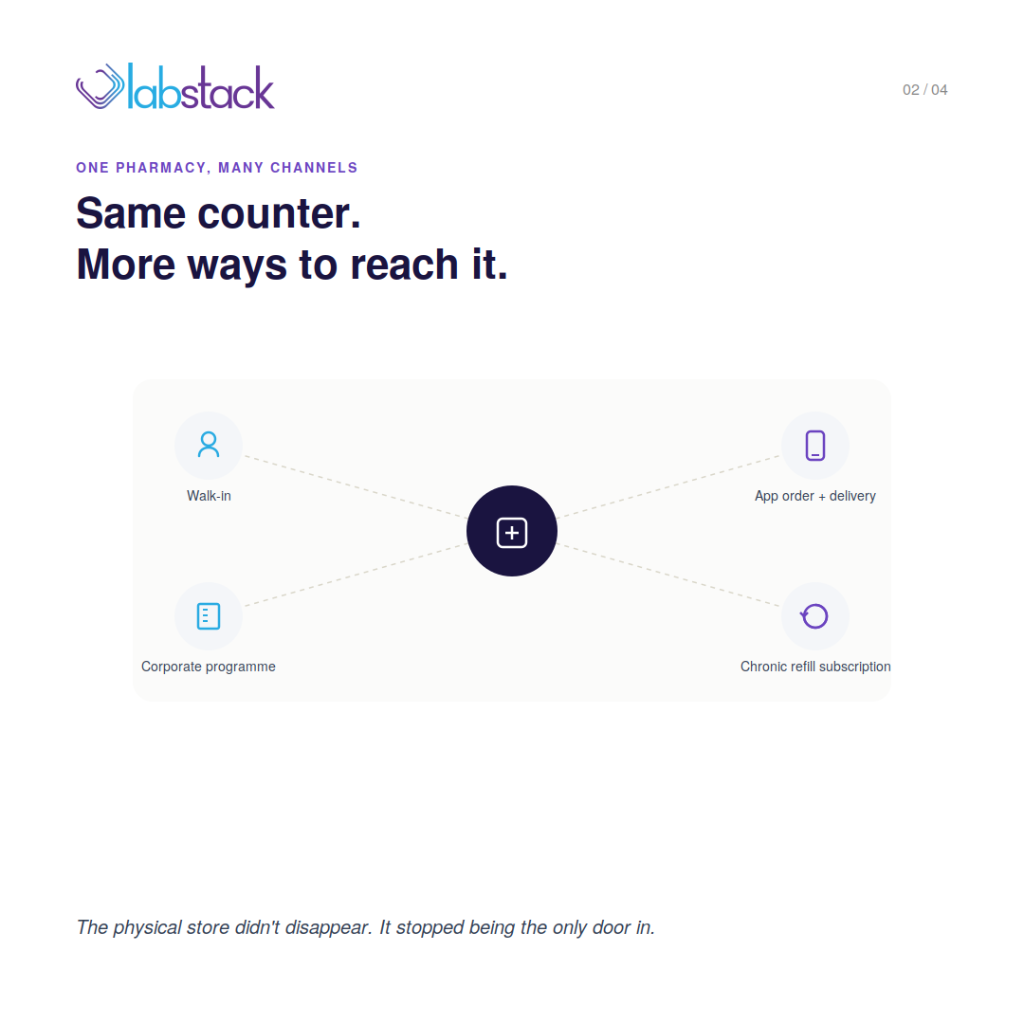
The rise of digital pharmacy in India did not eliminate the neighbourhood pharmacy. Instead, it introduced another way for people to access pharmacy services. A patient can still walk into a local pharmacy, but they can also place an order digitally, request delivery, access their previous orders and interact with healthcare services without physically visiting the store.
This created an important change in consumer expectations. Convenience, availability and speed became part of the pharmacy experience. The pharmacy was no longer defined only by its physical location. Its ability to serve a patient increasingly extended beyond the counter, powered by the same wave of pharmacy technology in India reshaping how orders move.
For traditional pharmacies, this did not necessarily mean choosing between physical and digital. It created the concept of an omnichannel pharmacy in India, where the physical store remains important while digital channels extend its reach.
The Pharmacy Started Becoming Part of Longer Healthcare Journeys
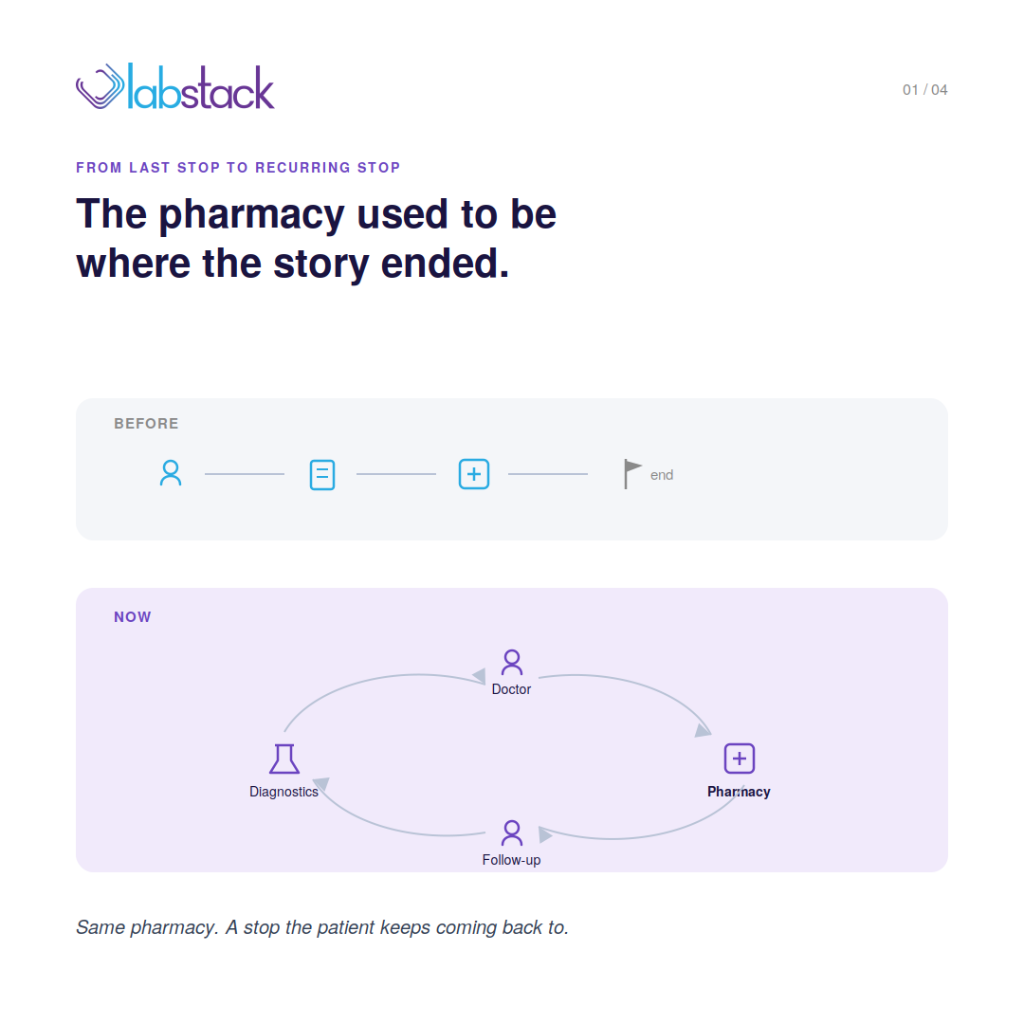
The traditional healthcare journey could be viewed as a sequence: doctor consultation, prescription, pharmacy. But many healthcare requirements do not end when medicines are dispensed.
A person managing diabetes, hypertension or another chronic condition may need medication repeatedly, periodic diagnostic testing, follow-up consultations and ongoing monitoring. A patient recovering from an illness may need medicines alongside follow-up care. An employee participating in a corporate health programme may interact with doctors, diagnostic providers and pharmacies as part of the same healthcare programme — an early picture of what the pharmacy's role in patient care looks like once it's no longer a single transaction.
The pharmacy therefore increasingly sits inside a longer healthcare journey, part of genuine pharmacy in continuity of care, rather than simply at the end of one.
Chronic Care Changed the Relationship Between Patients and Pharmacies
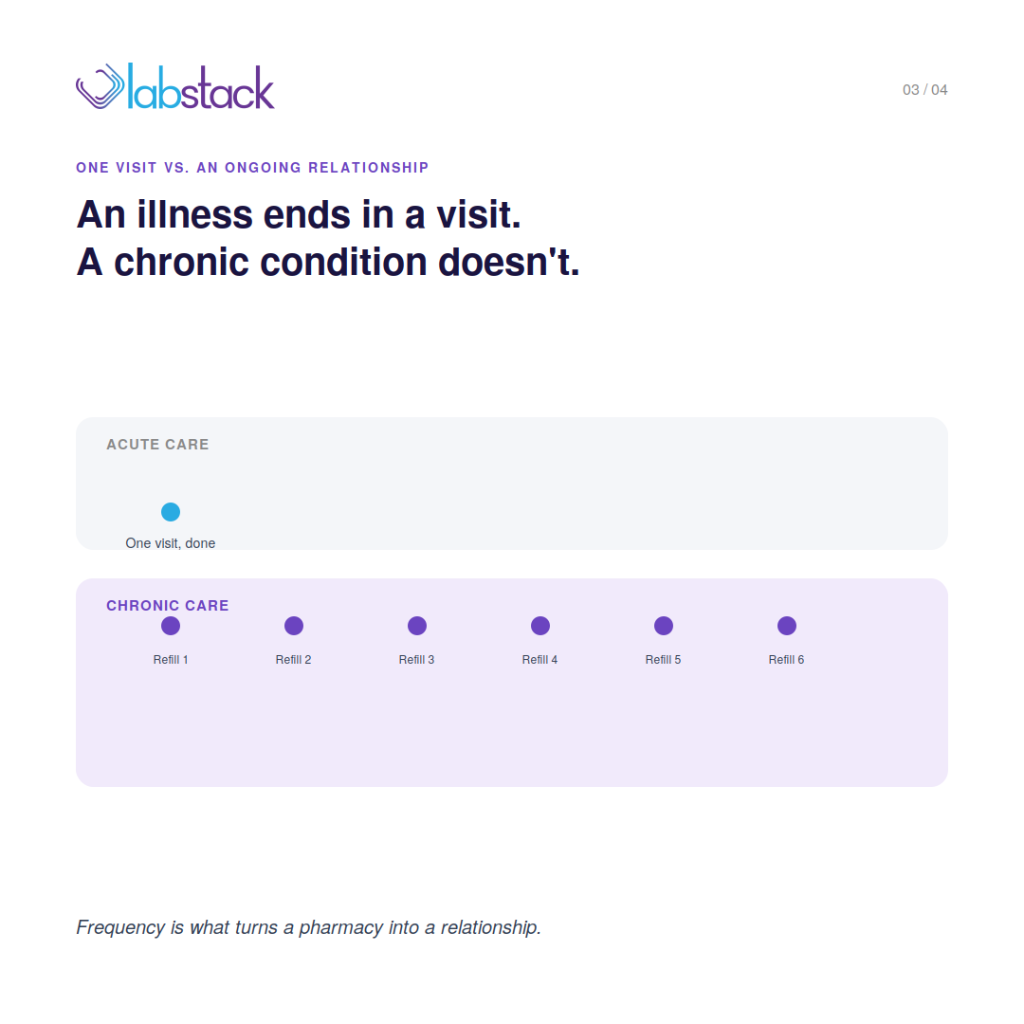
Acute healthcare can be episodic. A patient becomes unwell, sees a doctor, receives treatment and eventually stops interacting with the healthcare system. Chronic healthcare is different. The patient may need medication and monitoring for months or years. This creates repeated interactions with pharmacies and makes continuity increasingly important — the core logic behind pharmacy and chronic disease management.
The pharmacy can become one of the most frequent points of contact in that journey because medicines need to be obtained repeatedly. This gives pharmacies a role that extends beyond a single transaction. Refill behaviour, medication adherence in India and ongoing patient interaction all become part of the relationship, and medication management in healthcare starts to depend as much on the pharmacy as it does on the original prescription.
That shift is particularly important as India deals with a growing burden of non-communicable diseases and an ageing population. The pharmacy is increasingly operating as a form of community pharmacy healthcare within journeys that are continuous rather than one-time.
Digital Healthcare Connected the Pharmacy to More Than the Patient
The larger change is happening around the pharmacy.
A pharmacy can now sit alongside digital consultations, diagnostic testing, health records, insurance and other healthcare services. A patient may consult a doctor digitally, receive a prescription, complete diagnostic testing and obtain medicines without interacting with each provider through a completely separate process.
India's Ayushman Bharat Digital Mission is building interoperability across healthcare providers and facilities, including pharmacies, doctors, hospitals and diagnostic laboratories. Its objective is not simply to digitise individual healthcare services, but to create healthcare infrastructure through which different parts of the pharmacy healthcare ecosystem can connect.
That changes the pharmacy's position in the ecosystem. It is no longer necessarily an isolated retail endpoint. It can become one connected pharmacy component of a patient's broader healthcare journey.
The Physical Pharmacy Still Matters
The growth of digital healthcare does not mean the neighbourhood pharmacy is becoming irrelevant. India's online pharmacy industry remains built on top of, not instead of, physical retail, particularly because pharmacies provide immediate access, local familiarity and face-to-face interaction. What has changed is that the physical store no longer has to be the only channel through which a pharmacy operates.
A pharmacy can maintain its local presence while also accepting digital orders, providing online medicine delivery India, participating in healthcare programmes and connecting with other healthcare providers. The competitive difference increasingly comes from how effectively these channels work together — a fair way to answer how omnichannel pharmacy is changing healthcare in practice.
The future therefore isn't necessarily online pharmacy versus offline pharmacy. It is increasingly about how well a pharmacy can operate across both.
The Pharmacy's Role Is Expanding Beyond Medicine Dispensing
As healthcare becomes more connected, the pharmacy can participate in several points of the healthcare journey. Medication fulfilment remains central, but the surrounding ecosystem can include chronic-care programmes, pharmacy and preventive healthcare, corporate health services, diagnostic partnerships and digital health platforms. This creates a broader definition of what a pharmacy can be, and it's really the honest answer to how the role of pharmacies is changing across the industry.
The pharmacy does not need to become a hospital or a clinic. Its value comes from the role it already occupies: it is geographically close to patients, frequently visited, deeply embedded in local communities and directly connected to the products and services people need to continue their care. That makes the pharmacy a potentially important access point within a more distributed healthcare system, and part of what makes it genuinely pharmacy as part of healthcare rather than adjacent to it.
The Next Shift Is From Digital Pharmacy to Connected Pharmacy
The first stage of digital transformation of pharmacy was largely about convenience: find the medicine, order it online and get it delivered. The more significant next stage is connectivity: how does the pharmacy fit into the healthcare journey surrounding that medicine? That's the real substance behind how digital pharmacy is changing healthcare beyond the delivery step.
A doctor generates a healthcare requirement. A diagnostic laboratory may generate information. An insurer or corporate programme may enable access. A pharmacy fulfils part of the resulting healthcare need. Other providers may become involved in follow-up care.
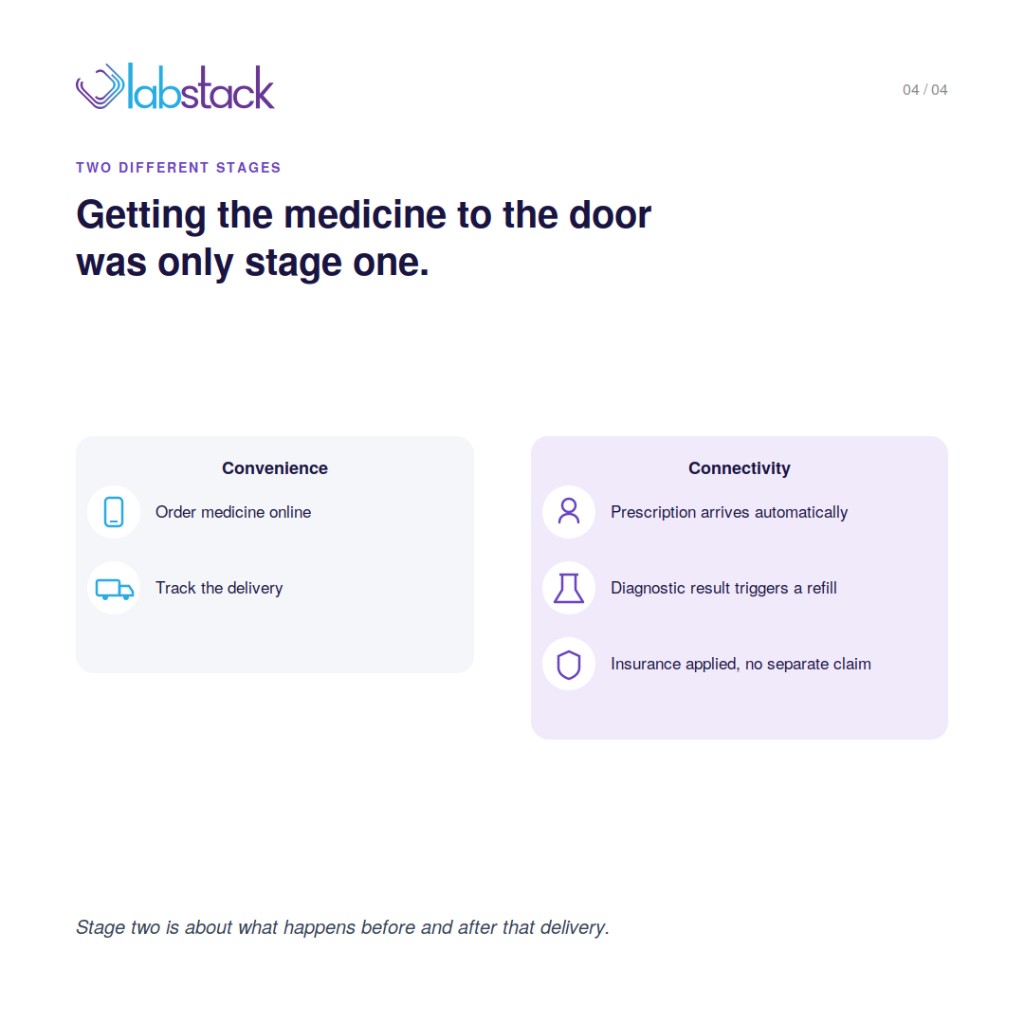
When these interactions become connected, the pharmacy is no longer simply receiving a customer after the doctor has finished their job. It becomes part of the network through which healthcare is delivered — an early answer to how pharmacies are becoming part of connected healthcare, built on something closer to a single integration layer and connected provider workflows than a separate arrangement with every doctor, lab and insurer involved.
The Pharmacy Is Moving From the End of the Journey Into the Journey Itself
The biggest change in pharmacy digital healthcare over the last few years is therefore not simply the rise of online medicine ordering. It is the changing position of the pharmacy within healthcare — arguably the clearest sign yet of the evolution of pharmacy in India underway right now.
The pharmacy still dispenses medicines. But it is increasingly operating in a healthcare environment where patients expect digital access, ongoing support and greater continuity across different providers.
The pharmacy used to be where the doctor's decision ended. In a connected healthcare system, it can become one of the places where the patient's healthcare continues.