
Indian Hospitals Are Expanding Beyond Metros. What Changes When Healthcare Moves Closer to the Patient?
India's hospital sector is entering a phase where growth is no longer concentrated only in the country's largest metropolitan cities. Hospital expansion in India is increasingly aimed at Tier 2 and Tier 3 cities, driven by rising healthcare demand, improving insurance coverage, increasing health awareness and the growing need for organised medical infrastructure outside traditional healthcare hubs. For patients, this can mean access to specialised treatment closer to home instead of travelling to a major city for every complex medical requirement. For hospitals, however, entering these markets is not simply a matter of opening a new facility. It means becoming part of a healthcare ecosystem that may already have its own doctors, diagnostic centres, pharmacies, employers, insurers and referral patterns.
Healthcare Demand Is Growing Outside India's Major Healthcare Hubs
For a long time, patients in smaller cities often had to travel to metropolitan centres when they needed specialised or advanced healthcare. This created a concentration of both healthcare infrastructure and healthcare demand in cities that already had established hospital networks. As hospital operators expand into smaller cities, that pattern is beginning to change — part of a broader shift in healthcare access outside metro cities. More patients can now access organised healthcare within or closer to their own communities, while hospitals can address demand that previously flowed toward larger cities. It's a natural next question: how are hospitals expanding beyond metro cities, and what does that expansion actually require of them once they arrive.
This expansion is also changing where healthcare organisations see growth opportunities. A hospital entering a Tier 2 or Tier 3 city is not simply opening another branch — it is part of the wider growth of hospitals beyond metro cities now under way across India. It is entering a market where healthcare demand may already exist but is distributed across local doctors, diagnostic providers, employers, insurance networks and smaller healthcare facilities. Understanding and connecting with that existing ecosystem becomes as important as building the physical infrastructure itself.
A New Hospital Does Not Enter an Empty Healthcare Market
When a hospital opens in a new city, it becomes one part of an existing healthcare system rather than the entire system. Patients may already have relationships with local physicians, diagnostic laboratories and pharmacies. Employers may already have healthcare arrangements for their employees, while insurers and TPAs may already be serving members in the region. These existing relationships influence where patients seek care, how they are referred and which providers they interact with before and after a hospital visit — which is really the question behind how hospitals integrate with local healthcare ecosystems once the building itself is finished.
This means hospital expansion creates a different kind of challenge. The hospital may bring new specialties, equipment and clinical capabilities into the market, but those capabilities still need pathways through which patients and healthcare organisations can access them. A specialist department cannot create its full potential simply by existing inside the hospital. It becomes valuable when the surrounding healthcare ecosystem in Tier 2 cities knows it is available and can connect relevant requirements to it.

Moving Healthcare Closer to Patients Changes the Patient Journey
When specialised healthcare closer to patients becomes the norm rather than the exception, the patient's journey can become less dependent on a single large metropolitan hospital. A patient may begin with a local consultation, undergo diagnostics nearby, be referred to a specialist at the expanding hospital and then continue treatment through a combination of hospital, pharmacy and follow-up services. This is, in effect, what changes when hospitals move closer to patients — not just where care happens, but how many organisations end up touching a single patient's journey.
The result is a more distributed healthcare journey — an early shape of what distributed healthcare infrastructure in India could look like at scale. Different providers may contribute to the same patient's care without operating from the same organisation or location. As hospital networks expand geographically, this becomes increasingly important because the hospital is no longer only competing for patients who walk through its own doors. It is becoming one destination within a larger network of healthcare interactions.

Hospital Expansion Also Expands the Need for Local Healthcare Connections
A hospital entering a new market needs more than awareness among patients. It needs relationships with the healthcare professionals and organisations that already generate and influence healthcare demand in that market. Local doctors can refer patients who need specialist care. Corporates can create structured healthcare requirements for employees. Insurers and TPAs can direct covered healthcare services toward eligible providers. Diagnostic providers can become part of referral and treatment pathways — the many threads that make up connecting hospitals with healthcare providers in any new market.
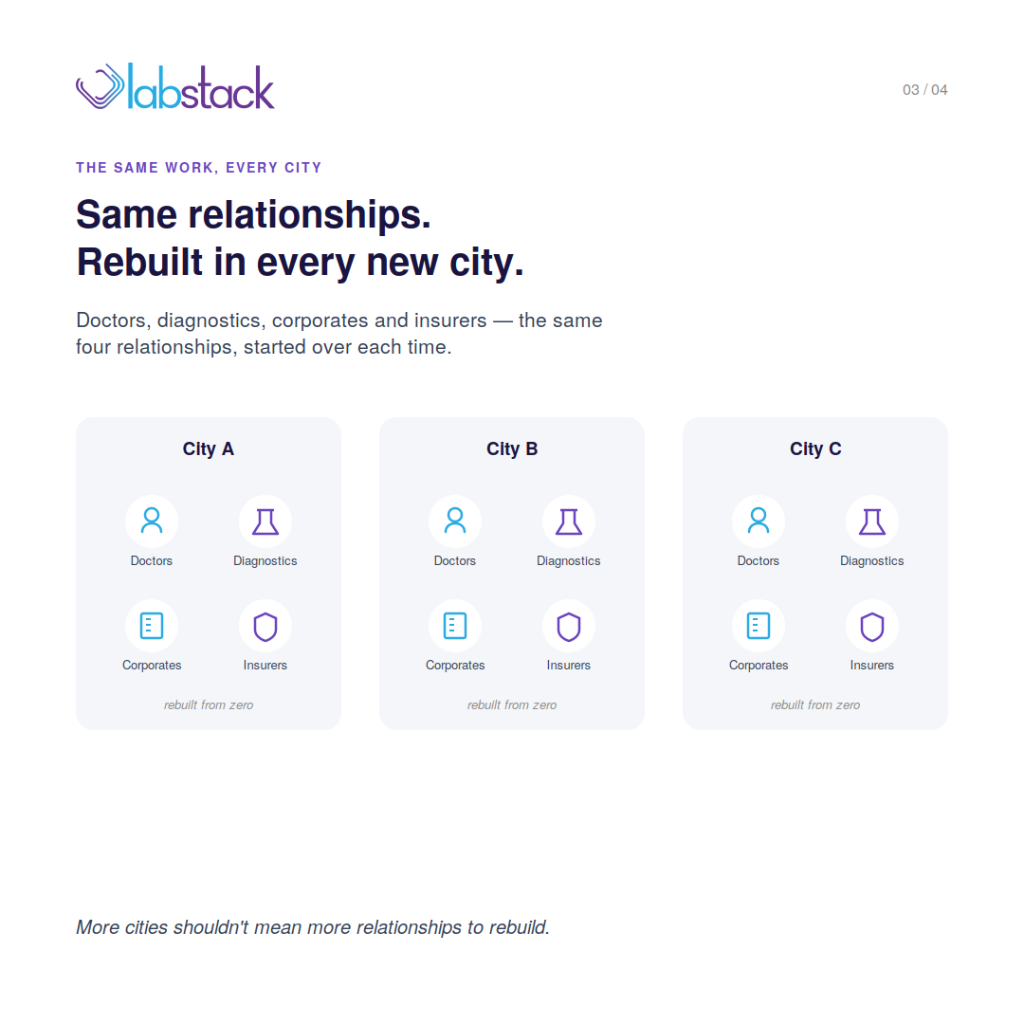
Building these connections can be difficult when every new hospital location requires the organisation to develop a completely separate hospital referral network from the ground up. The problem becomes even more complex for hospital groups expanding across multiple cities, where every location has different providers, organisations, capabilities and patterns of demand. The larger the geographic footprint becomes, the more important it is to have a reliable way of connecting the hospital with the healthcare ecosystem around each location.
The Definition of Hospital Accessibility Is Changing
Bringing a hospital closer to patients solves an important part of the accessibility problem, but physical proximity is only one component of access. Patients also need to be able to reach the right specialty, discover the available service, receive referrals, use their insurance or corporate healthcare benefits and continue their care after the hospital visit — the fuller meaning behind improving healthcare access in India beyond simple proximity.
This is why the growth of hospitals beyond metros is also a story about connectivity. As healthcare infrastructure expansion in India becomes more geographically distributed, the relationships between providers become increasingly important. A patient may be physically closer to a hospital than ever before — part of improving healthcare access in Tier 2 cities India and healthcare access in Tier 3 cities India alike — but the healthcare journey still depends on whether the different organisations involved can work together effectively.
The Next Phase of Hospital Growth Will Depend on More Than Physical Infrastructure
Hospital expansion will continue to create new healthcare capacity across India, but capacity alone does not determine how much value that infrastructure creates. A hospital can invest in beds, equipment, specialists and facilities, yet its ability to grow in a new market ultimately depends on how effectively those capabilities become part of the healthcare demand already present there. This is close to the real answer to what the future of hospital expansion in India looks like — less about how many facilities open, and more about how well each one plugs into what already exists around it.
This is particularly important as hospital networks expanding in India move into more and more cities. Each new location brings its own healthcare ecosystem, and connecting that ecosystem to the hospital can become an important part of hospital expansion and healthcare networks growing together rather than separately. The hospital needs to be discoverable not only by individual patients, but also by the doctors, employers, insurers, TPAs and healthcare organisations that influence where those patients receive care.
From Expanding Hospitals to Connected Healthcare Networks
The expansion of healthcare facilities in India is therefore changing more than the physical location of healthcare infrastructure. It is gradually creating a more distributed healthcare system in which hospitals and healthcare networks in India — doctors, diagnostic laboratories, pharmacies, insurers, employers and home-care providers — can all contribute to the same healthcare journey.
For hospitals, this creates a broader definition of growth. Opening a facility establishes the capacity to provide care in a new market. Building the right connections determines how deeply that facility becomes integrated into the market. What that ultimately calls for is less a patchwork of one-off referral arrangements and more of a single integration layer — a shared, connected provider workflows logic that lets a new hospital plug into an existing ecosystem instead of rebuilding every relationship, city by city, from nothing.

As healthcare moves closer to the patient, the next opportunity is not simply to build more hospitals. It is to connect the hospitals being built with the healthcare infrastructure already serving those patients.