
Your Hospital Was Built to Treat Patients, Not Chase Demand
A hospital is built around an enormous investment in healthcare infrastructure. Specialist doctors, diagnostic departments, operating rooms, beds, medical equipment, clinical teams, technology and support services all have to come together before a hospital can deliver care at scale. That investment is made with an expectation that the capacity being created will be used consistently enough to justify the cost of building and operating it.
But having the capacity to treat more people does not always mean having enough demand to use it. A hospital can have specialists with available appointment slots, diagnostic departments capable of handling more investigations, procedure rooms with available capacity and facilities that are ready to serve more patients — while parts of that infrastructure remain underutilised. Nothing is necessarily wrong with the hospital itself. The capability exists. The infrastructure exists. What is missing is a reliable connection between that capacity and the healthcare demand that could use it.
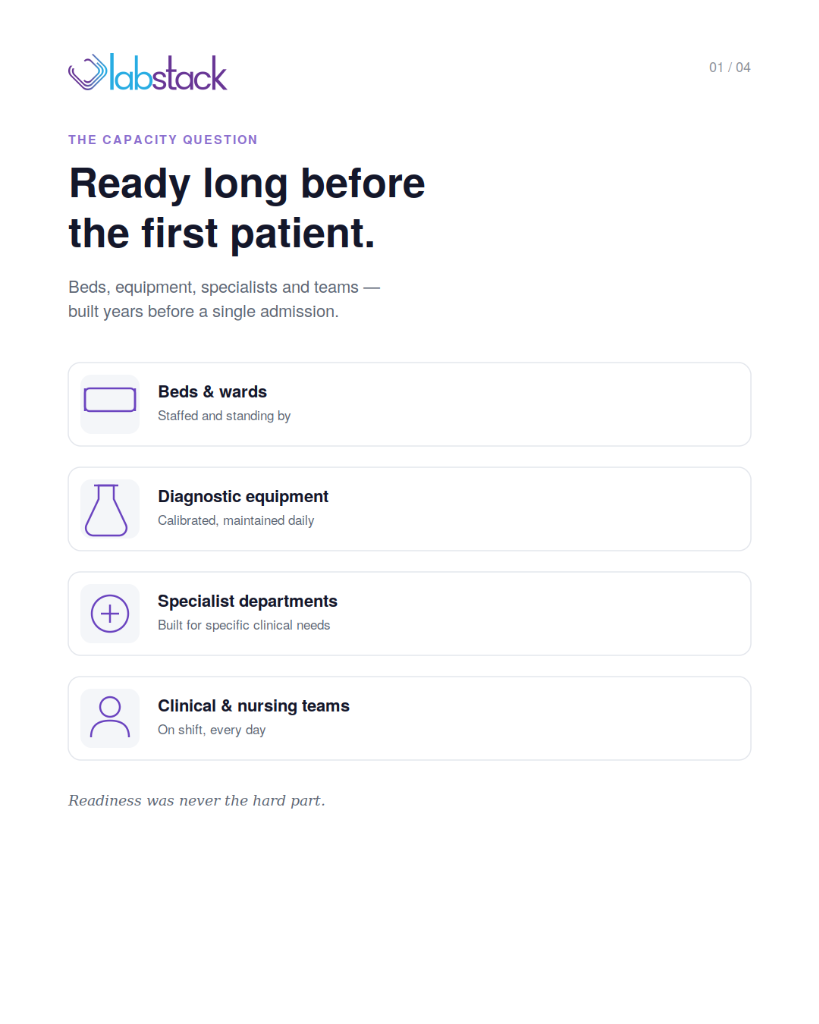
Hospital Capacity Can Remain Underutilised Even When the Facility Is Fully Operational
Underutilisation does not necessarily look like an empty hospital. It can happen quietly across individual departments and services. A specialist may have appointments available on a particular day, a diagnostic department may be processing fewer investigations than it is equipped to handle, or a procedure room may have unused slots. The hospital continues to operate normally, but some of the capacity it has already invested in is not generating its full potential.
This is, at its core, a question of hospital capacity utilisation in India — and it matters because most hospital costs do not disappear when capacity goes unused. Clinical teams still need to be staffed, equipment still requires maintenance, facilities still need to operate, and technology and support infrastructure still have to be maintained. Unused hospital capacity is also time-sensitive: once an appointment or procedure slot goes unused for the day, it cannot be stored and recovered later.
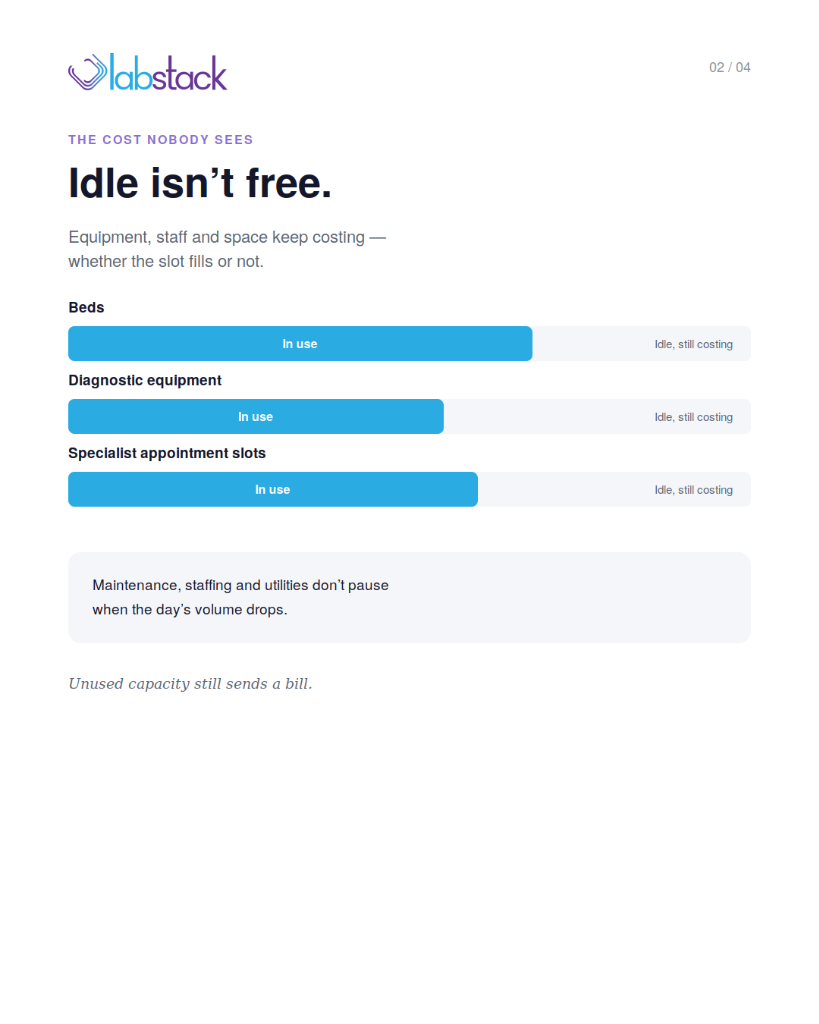
For hospitals that have already invested heavily in their infrastructure, improving resource utilisation can be as important as expanding capacity.
That raises the natural next question: how do hospitals increase patient volume without simply waiting for walk-ins?
Insurers, TPAs and Corporate Health Programmes Generate Demand Beyond Traditional Hospital Channels
Not all hospital patient demand reaches hospitals through walk-ins and individual referrals. Insurers and TPAs manage policyholders who require healthcare services under their benefits. Corporates run employee health programmes, preventive health checks and OPD benefits. Digital health platforms and other healthcare businesses also serve populations that require physical healthcare services across different locations.
This is where corporate healthcare demand for hospitals starts to matter. The challenge is that this demand does not automatically reach every hospital capable of fulfilling it. A hospital may have the right specialists, facilities and clinical capabilities but have no direct connection to the organisation generating the demand. The demand exists somewhere in the healthcare ecosystem, while the capacity exists inside the hospital. Connecting the two often requires a separate network of commercial and operational relationships.
Hospital Empanelment and Business Development Can Become a Separate Operational Burden
Accessing organised healthcare demand for hospitals is rarely as simple as signing up for a platform. Hospitals may need to go through empanelment, documentation, quality checks, commercial negotiations and operational setup for each new organisation they work with. Once the relationship is established, it also needs to be maintained. Orders have to reach the right departments, service requirements have to be met, and the hospital has to coordinate with the organisation sending the demand.
For large hospital groups, this can be supported by dedicated business development and partnership teams. For regional and independent hospitals, building every relationship independently can consume significant time and resources that would otherwise go into hospital operational efficiency. The hospital ends up having to solve two different problems at once: delivering healthcare, and building the hospital referral network through which more healthcare demand can reach it.
Every New Demand Source Can Create Another Relationship to Manage
The difficulty increases as a hospital works with more organisations. One insurer may have one process, a corporate programme another, and a digital health platform another. Each relationship can involve its own commercial terms, documentation, workflows and coordination requirements — a growing hospital demand management load with no shared structure underneath it.
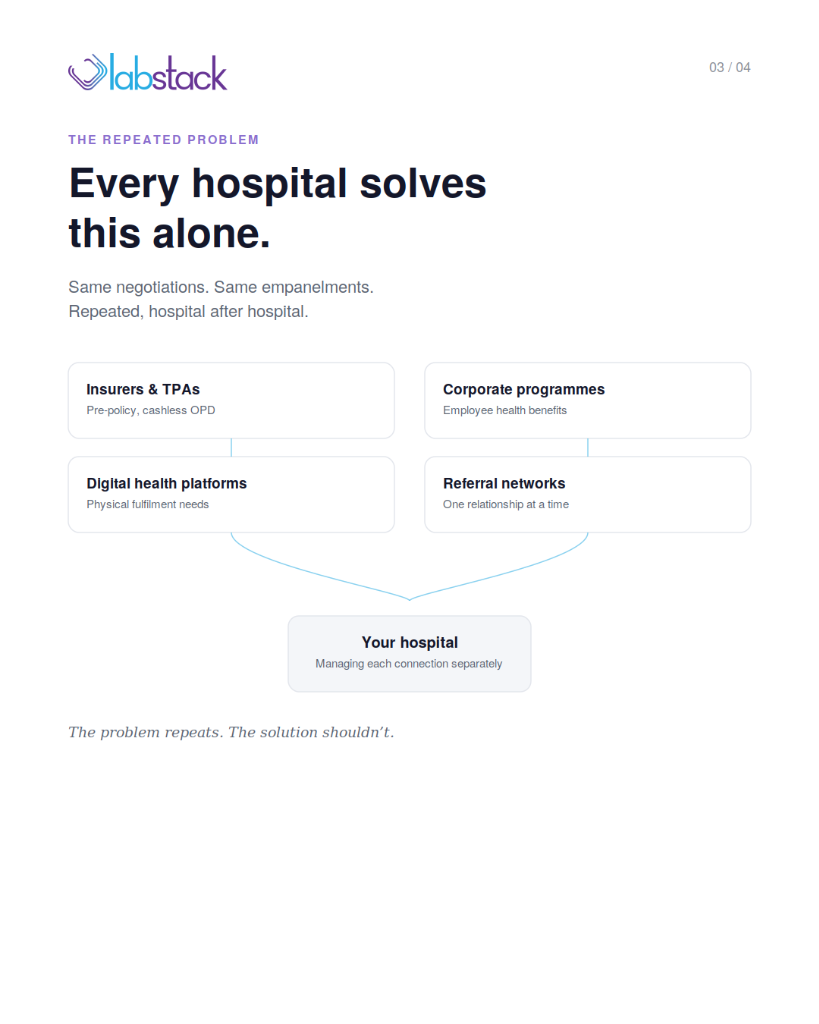
This creates fragmentation on both sides. Healthcare businesses have to build and maintain their own provider networks, while hospitals have to independently build relationships with organisations that can generate demand. The same connectivity problem is therefore solved repeatedly across the ecosystem, with each individual relationship adding another layer of operational complexity — and, for the patient at the centre of it, another risk to continuity of care if any one link is coordinated poorly.
Healthcare Demand and Hospital Capacity Are Not Always Connected Efficiently
The healthcare ecosystem already has both sides of the equation. There are organisations with populations that need healthcare services, and there are hospitals with the infrastructure and clinical capability to provide those services. The problem is often the infrastructure between them.
A hospital may be perfectly capable of fulfilling a requirement but remain outside the network through which that requirement is being routed. Similarly, an insurer, TPA or corporate may have demand in a particular location but spend considerable effort finding, validating and managing providers that can fulfil it. Without a common network layer, both sides continue to build connections independently — and questions like how hospitals can access organised healthcare demand are answered relationship by relationship instead of systemically.
This becomes especially important as healthcare demand becomes more distributed across cities and service categories. The challenge is no longer simply whether a hospital can provide a particular service. It is whether the hospital can efficiently connect its capability to the organisations and populations that need that service — a question of hospital capacity management as much as clinical capability.
Hospitals Should Not Have to Build Their Own Demand Network
A hospital's primary expertise is healthcare delivery. Its doctors, clinical teams and operational staff are there to provide coordinated patient care, not to independently construct a nationwide network of insurers, TPAs, corporates and healthcare platforms.
A connected healthcare network can take on part of that infrastructure problem by creating a common layer between organisations generating healthcare demand and providers capable of fulfilling it. Instead of every hospital having to discover and establish every relationship independently, relevant demand can be connected to providers based on factors such as location, service capability and operational requirements.
This allows hospitals to participate in a broader network without having to build every connection from scratch — and it reframes managing hospital capacity and demand from an internal operations problem into something a shared network layer can absorb.
LabStack Connects Organised Healthcare Demand With Hospital Capacity
LabStack is built as a healthcare infrastructure network connecting demand-side organisations such as insurers, TPAs, brokers, corporates and healthcare businesses with healthcare providers across India. For hospitals, this creates access to organised healthcare demand that can be routed according to their location and capabilities, through a single API infrastructure that coordinates fulfilment rather than adding another relationship to manage.
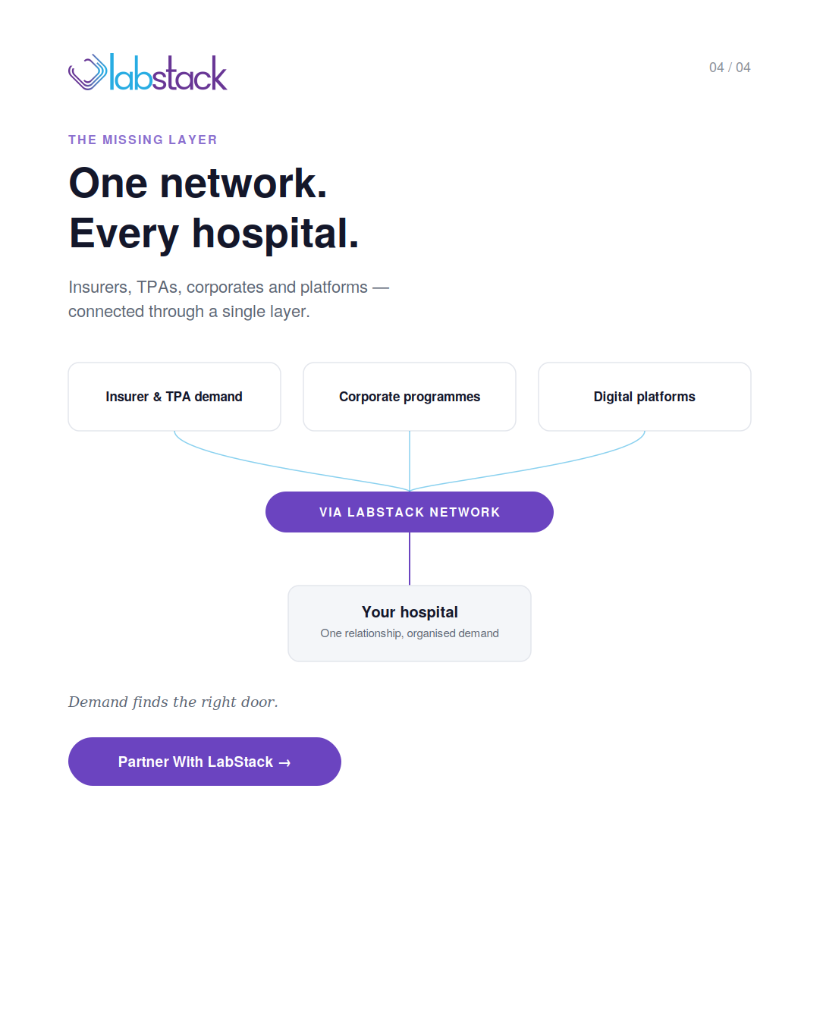
The objective is not simply to send more patients to hospitals. It is to make the capacity hospitals have already invested in more accessible and productive, by connecting it — through one API — to healthcare demand that already exists across the ecosystem.
A hospital has already done the expensive part. It has built the facility, invested in equipment, hired specialists and created the capability to deliver care. The next opportunity is making sure that more of that existing capacity is connected to the demand that needs it.