The Right Healthcare Professional Means Nothing If They Can't Reach the Patient
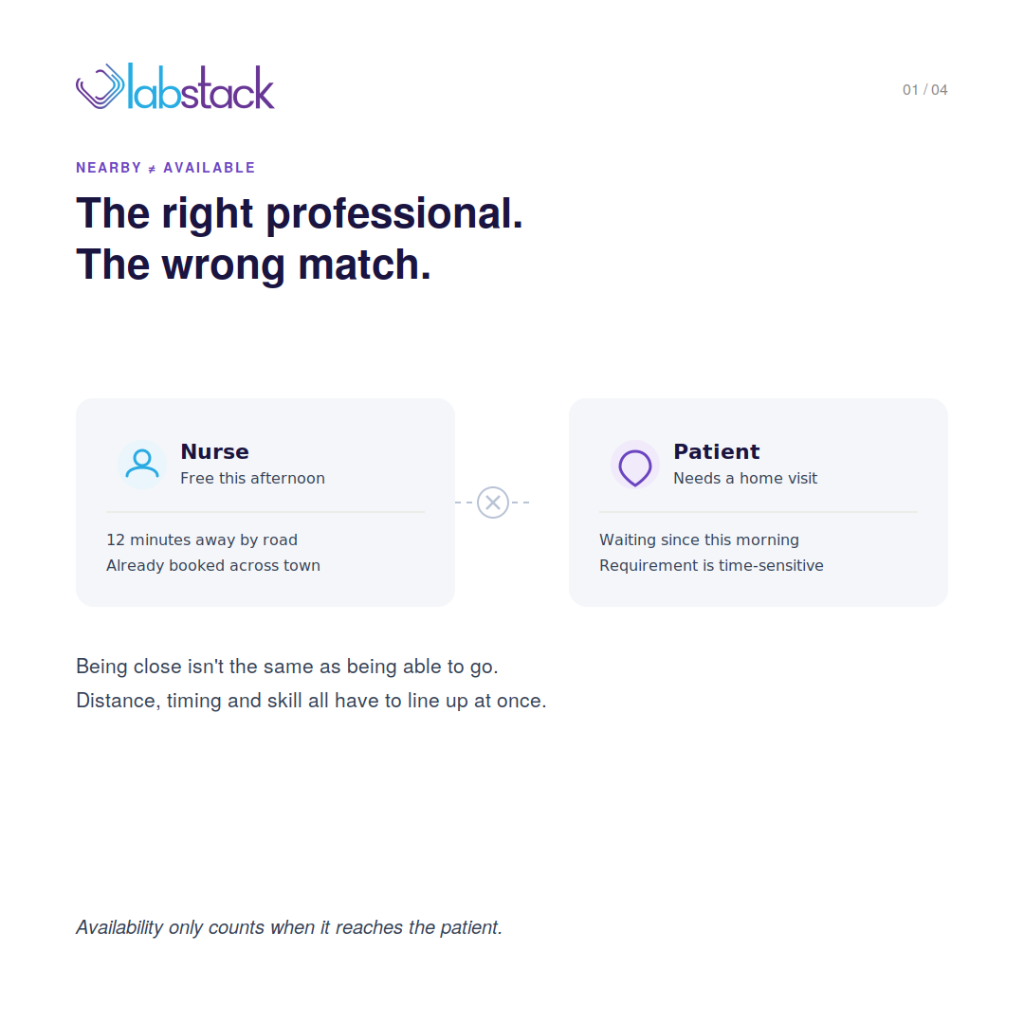
A nurse or phlebotomist can be fully qualified, experienced and available to take on another visit. The patient can also be ready and waiting for that service. Yet the visit may still not happen simply because the two cannot be connected at the right time and location. In home healthcare, having the right professional is only one part of the problem. The professional also has to be available where the patient is, at a time that works, with the right skills and service requirements.
This is fundamentally different from healthcare delivered inside a hospital or clinic. In a facility, patients travel to where the healthcare workforce is already located. In home nursing and patient care at home, the direction is reversed. The healthcare professional has to travel to the patient. Every appointment therefore carries another layer of coordination around distance, timing, availability and routing. A qualified professional sitting a few kilometres away may be practically unavailable if the assignment does not fit their schedule or route.
A Qualified Professional Is Not Automatically an Accessible Professional
Healthcare providers are often discussed in terms of how many professionals are available. But for home-based care, the more important question is why location is important in home healthcare — whether the right professional can actually reach the patient.
A nurse may have an open slot but be too far from the patient's location. A phlebotomist may be available that morning but already have collections scheduled across another part of the city. A patient may need a specific service that requires a particular skill set, while the closest available professional may not be qualified to provide it.
This means availability has to be understood in context. A professional is useful only when their availability, location, skills and the patient's requirement align.
Every Home Visit Has a Logistics Layer Behind the Healthcare
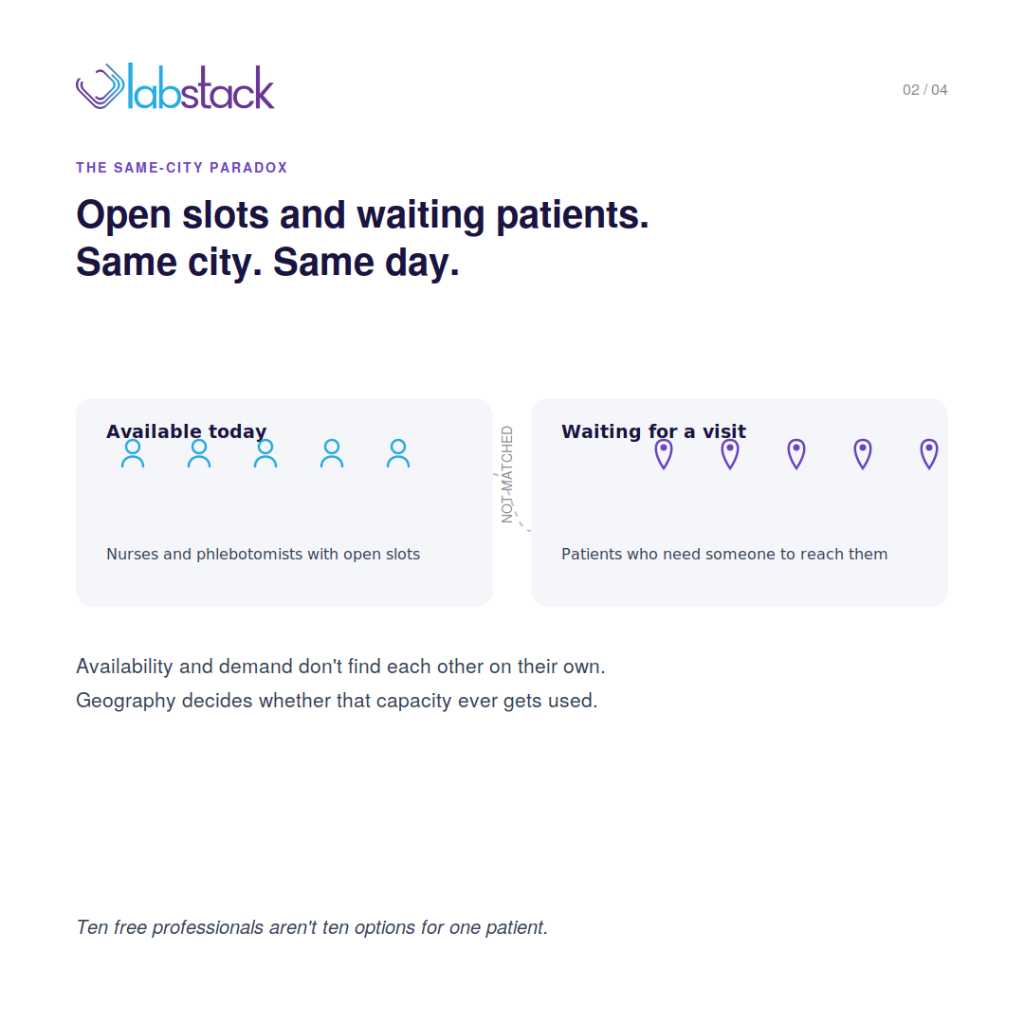
Before a nurse reaches a patient's home or a phlebotomist performs blood sample collection, several things have already needed to go right, forming the backbone of home healthcare logistics. The requirement has to be received, the patient's location has to be identified, the appropriate professional has to be selected, their availability has to be checked and the visit has to be scheduled within a workable time window through proper home visit scheduling.
None of this is the clinical service itself, but without it the clinical service cannot happen.
For a single visit, these steps may be manageable through calls and manual coordination. As the number of patients, providers and locations increases, however, the complexity grows quickly — which is part of why home healthcare coordination is difficult at any real scale. What looks like a simple home visit from the patient's perspective can involve multiple operational decisions behind the scenes.
The Same Healthcare Workforce Can Have Available Capacity and Unserved Demand at the Same Time
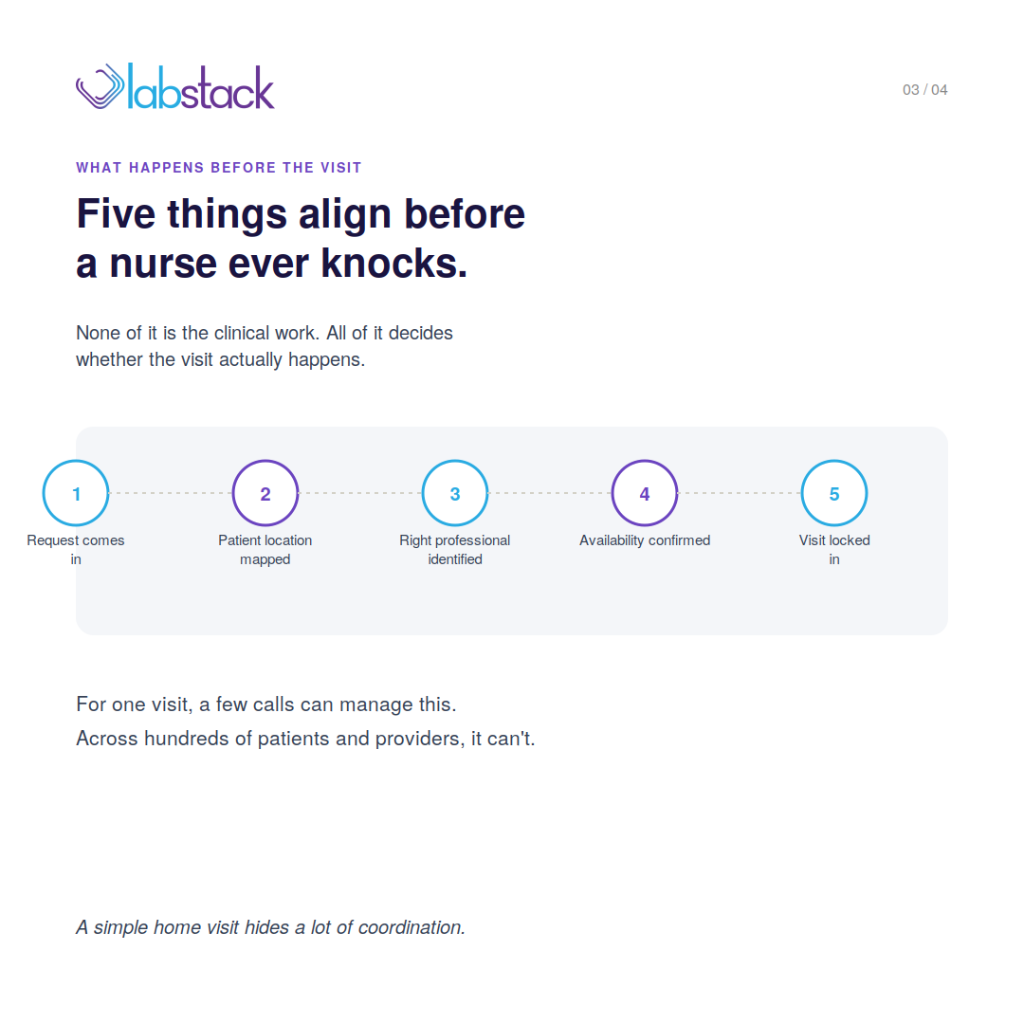
A city may have nurses and phlebotomists available for additional work while patients in that same city are waiting for home sample collection and other nursing services. This does not necessarily mean there are enough professionals in the exact location required at the exact time required. It means the available workforce and the incoming demand are not always being matched efficiently — a gap that nurse patient matching exists to close.
Geography makes this more difficult. Ten available professionals spread across a city are not equivalent to ten professionals who can all serve a patient in one particular neighbourhood. Travel time, appointment windows and service requirements determine whether that theoretical capacity can actually be used, and this is essentially what distributed healthcare looks like in practice.
The result is a strange contradiction: healthcare professionals can have unused availability while patients still struggle to find someone who can reach them.
Travel Time Becomes Part of Healthcare Capacity
For facility-based providers, a healthcare professional's working day is largely spent delivering care. For a mobile healthcare provider, part of that day is spent travelling between care locations.
A phlebotomist who performs several collections across a well-coordinated route — built through deliberate phlebotomy route planning — can potentially use their working hours far more efficiently than one travelling long distances between isolated appointments. Similarly, a nurse may be able to take more assignments when visits are scheduled around location and timing rather than handled independently, the core idea behind home visit route planning.
This makes provider utilisation more complicated than simply counting appointments. The same number of visits can require very different amounts of time and effort depending on how they are distributed geographically.
Growing Home Healthcare Means Coordinating More Than Just People
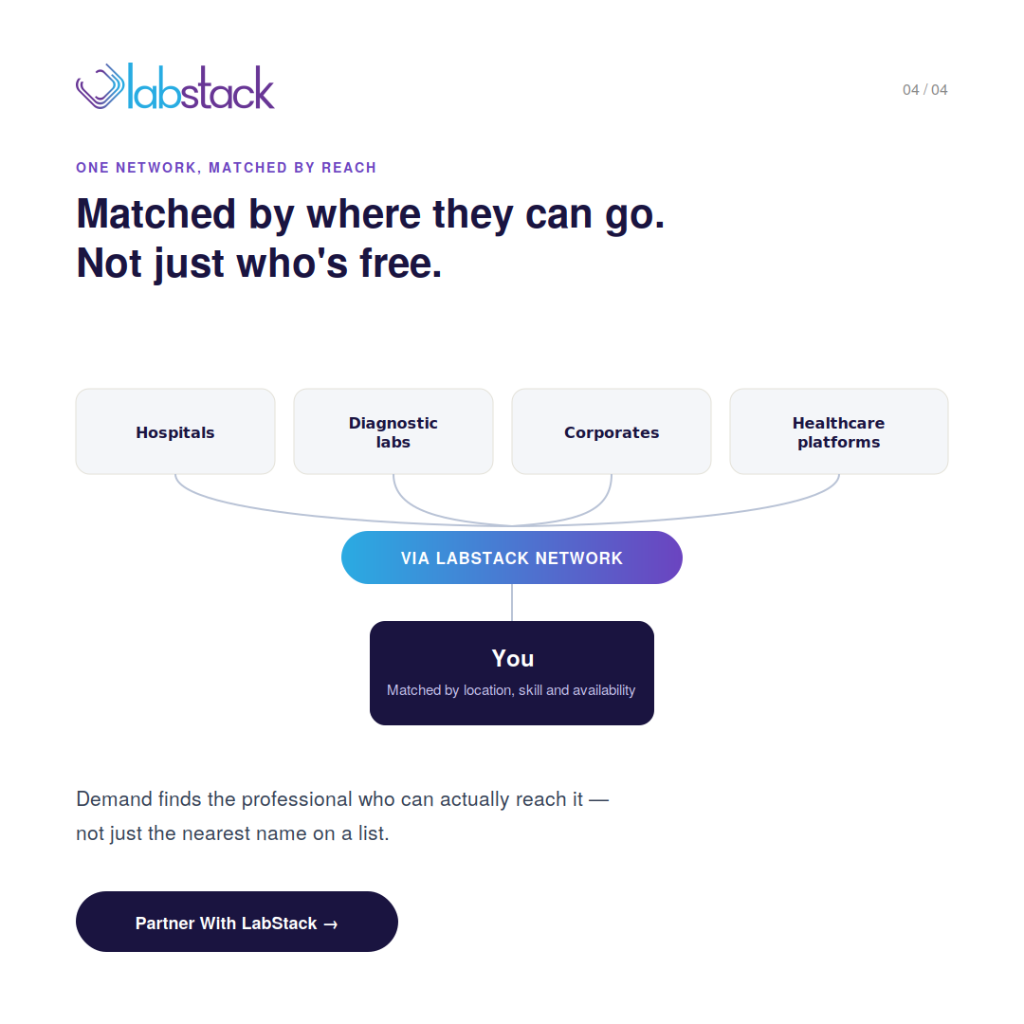
As home diagnostics and home-based care expand, the number of interactions between patients, providers and healthcare organisations increases. Hospitals may require post-discharge nursing support. Diagnostic laboratories may need home sample collection operations. Corporates may arrange health services for employees. Healthcare platforms may coordinate home-based services for their users.
Each of these organisations may have its own provider network and operational process. A nurse or phlebotomist can therefore receive demand from multiple sources without one common system through which those requirements are matched to their availability — the exact function of home healthcare provider network infrastructure and effective healthcare provider routing.
The provider ends up dealing with fragmented demand, while the organisation generating the demand has to solve the separate problem of finding and coordinating suitable professionals.
Nurses and Phlebotomists Should Not Have to Build Their Own Demand Network
A nurse's expertise is in providing care. A phlebotomist's expertise is in safe and accurate sample collection. Neither should have to independently build relationships with every hospital, diagnostic laboratory, corporate programme or healthcare platform that might need their services — the kind of nursing assignment management and phlebotomy appointment scheduling burden that has nothing to do with clinical skill.
Likewise, a healthcare organisation should not have to search for individual professionals every time a home-care requirement appears.
What is needed is an infrastructure layer that connects the two sides: the healthcare requirement and the professional capable of fulfilling it.
Matching the Right Professional to the Right Patient Is a Network Problem
Once the number of providers and healthcare requirements grows, matching cannot depend entirely on individual phone calls or disconnected provider lists — precisely how healthcare providers can match nurses to patients at any meaningful scale.
The relevant professional needs to be identified based on factors such as location, service capability, availability and the requirements of the assignment. The goal is not simply to find a nurse or a phlebotomist. It is to find the appropriate professional who can actually fulfil that particular requirement, which is really how home sample collection scheduling works when it's done well and how phlebotomy visits can be coordinated without constant manual intervention.
This is where a connected mobile healthcare workforce and home care workforce coordination becomes valuable. It turns provider availability into something that can be matched against real healthcare demand rather than leaving both sides to find each other independently.
LabStack Connects Healthcare Demand With Providers Who Can Reach It
LabStack connects healthcare organisations with providers across its network through a single API infrastructure, helping route healthcare requirements to relevant providers based on factors such as location and capability — one way healthcare networks can improve home care access without every organisation building its own version of the same routing layer.
For nurses and phlebotomists, this creates access to healthcare demand and connected provider workflows without requiring them to independently build every relationship with hospitals, diagnostic labs, corporates or healthcare platforms. For organisations generating the demand, it creates a way to access providers who can fulfil the requirement where the patient actually is, through one API rather than a separate connection for every source.
Because in home healthcare, having the right professional is only the beginning. The real value comes when the right professional can reach the right patient, at the right time, with the right service.